Learn about assistive technology for people with reading disabilities, dyslexia, low vision, blindness and other disabilities that make reading, writing, and other tasks difficult. Written by someone who uses assistive technology to read and write.

Showing posts with label Marketing Performance Measurement. Show all posts

4/16/14

Measuring Sales and Marketing based on Customer Outcomes

Have you ever used Uber X, the freelance taxi service? Half the cost of a cab and twice the level of service. The cars are immaculate. The drivers are almost overwhelmingly nice. They care deeply about your experience. Not because they want a tip. They want your 5-star feedback. That's so important to their success that they will do almost anything to make sure you are happy. It is a customer first model that works because customers have the ability to give feedback that has direct business impact. It's the eBay model applied to real world human interaction.
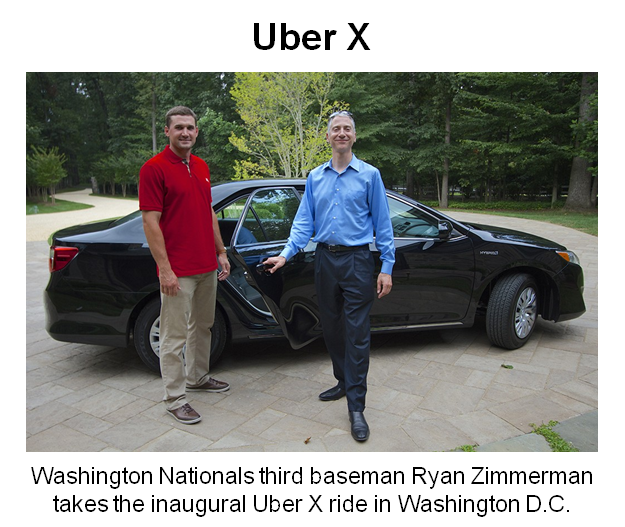
Think of your salespeople as Uber drivers, they interact with customers every day. Your marketing is like the car - is it in the right place at the right time and taking the customer where they want to go? These things matter tremendously to customers and yet we have no means to empower them to drive the behavior of marketing and sales at the moment of engagement. We have customer satisfaction surveys. They are important but lack immediacy and context for sales and marketing.

I recently came across two articles that may be the proverbial starting gun for measuring customer focus. The first from the HBR blog, "Bonuses Should be Based on Customer Value not Sales Targets," profiles how GlaxoSmithKline no longer calculates sales bonuses based on prescription drug sales but on a basket of metrics related to patient outcomes. The second on the Forbes blog, "The 5-Star Employee, Why we need a Yelp for Business" presents a provocative picture of why employee ratings should be standard practice.

Clearly there are cultural and generational issues at stake and a lot of education needed to make these transformations acceptable and actionable in a way that improves outcomes for everyone. As customer facing technology coalesces around the CX Cloud model, marketers should think about how to get customer feedback more frequently. It will require innovation born of experimentation. Of course, no one wants to rate every piece of collateral. But maybe every third touch or at specific points in the nurturing process. Companies that figure it out will have the great advantage of being able to monitor customer experience and course correct in flight as opposed to relying on satisfaction surveys that are too little too late. Best of all, customers will feel the power of the relationship, something they won't get from traditional models. Uber X is not better just because it costs less, it delivers more at the same time.

10/12/11

CMO's report universal lack of preparedness for key challenges

IBM released the findings of their Global CMO study yesterday and one of the primary conclusions is that CMOs feel unprepared to address key challenges. The most surprising thing is how consistent the feeling is across regions and vertical industries. CMOs generally face the same issues and report very similar levels of "unpreparedness" in the face of them. Top challenges include: data explosion, social media, growth of channel and device choices, and shifting consumer demographics, among others.
The findings are based on 1,734 structured in-person interviews with CMOs in large organizations conducted between February and June of 2011.Regional and vertical representation was reasonably well balanced. The sheer scale of the effort and the willingness of so many CMOs to participate indicate a role under siege.
In our research, IDC has learned that marketing is undergoing fundamental and painful transformations on several levels: new and expanding datasets, new channels and forms of communication, new tools and infrastructure requirements, new dynamic in customer acquisition, new pressure to prove business impact, new skills required for success. It is a multi-dimensional change that has many marketing leaders struggling to keep up.
The IBM study provides a strong basis for CMOs to educate their C-level peers on the challenges they face. However, by design, it does not offer practical models for addressing the issues. IDC has strong evidence that the customer data record is the fundamental design principle around which all customer facing activities and systems should be (re-)built. The customer record is increasingly the source for strategic insight, tactical planning, and performance metrics. Any marketer working in an organization without an enterprise customer creation process (with the requisite standards for customer records, data governance, and the infrastructure to support it) is set up for failure.
Unfortunately hardly any companies today manage customer creation as an enterprise process. We believe that this is the root of the universal "unpreparedness" revealed in the IBM Global CMO study. Having a practical model for implementing an enterprise customer creation process is the first step toward mastering all the key challenges CMOs and their marketing organizations are facing today.
ENTERPRISE customer creation is not something that only happens in marketing and/or sales. It encompasses every customer touch point over the lifetime of the relationship. It goes beyond the jurisdiction of any departmental leader and therefore must have C-level (CEO) endorsement and active support. It is the demand side equivalent of supply chain automation and we all know how WalMart conquered the world by mastering that side of the economic coin. On the demand side, the challenge is finding and forming relationships with prospective customers much earlier using channels and resources not traditionally thought of as marketing (or sales.) In addition the relationship needs to be tracked consistently from marketing to sales to finance, provisioning/fulfillment, support, etc - i.e. the customer data record must be uniformly defined and managed across departments. All the information associated with a customer record must be available to everyone involved in the process. It is a massive undertaking on par with the supply chain automation effort, but the reward is being months ahead of your competitors in terms of customer contact and relationship building – a key competitive advantage that will be very hard to displace.