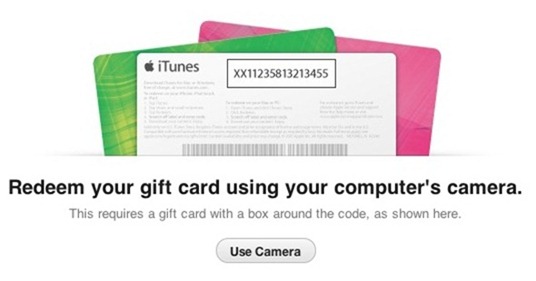
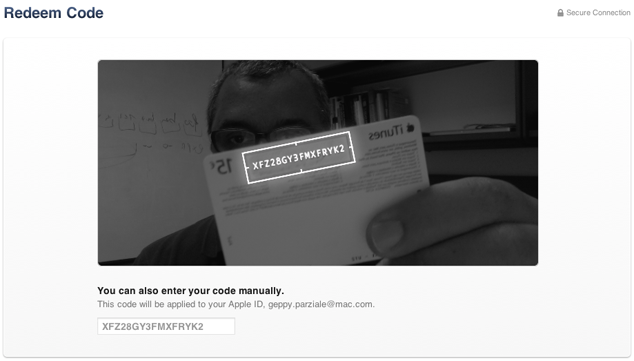
.PNG "Redeem gift card with camera screen in iOS 7")








 |
| Picture of Newspaper Article taken with iPhone 4S |
Economic Slide Took A Detour at Capitol Hill From Page A1 group.congress has never been a place for paupers. From plantation owners in the pre-Civil War era to industrialists in the early 1900s to ex-Wall Street financiers and Internet executives today, it has long been populated with the rich, including scions of families like the Guggenheims, Hearsts, Kennedys and Rockefellers.But rarely has the divide appeared so wide, or the public contrast so stark, between lawmakers and those they represent.The wealth gap may go largely unnoticed in good times. "But with the American public feeling all this economic pain, people just resent it more," said Alan J. Ziobrowski, a professor at Georgia State who studied lawmakers' stock investments.There is broad debate about just why the wealth gap appears to be growing. For starters, the prohibitive costs of political campaigning may discourage the less affluent from even considering a candidacy. Beyond that, loose ethics controls, shrewd stock picks, profitable land deals, favorable tax laws, inheritances and even marriages to wealthy spouses are all cited as possible explanations for the rising fortunes on Capitol Hill.What is clear is that members of Congress are getting richer compared not only with the average American worker, but also with other very rich Americans.While the median net worth of members of Congress jumped 15 percent from 2004 to 2010, the net worth of the richest 10 percent of Americans remained essentially flat. For all Americans, median net worth dropped 8 percent, based on inflation-adjusted data from Moody's Analytics.Going back further, the median wealth of House members grew some two and a half times between 1984 and 2009 in inflation.adjusted dollars, while the wealth of the average American family has actually declined slightly ha that same time period, according Emmar/e Huetteman and Derek Willis t'ontrihutPd rvrmrtino to data cited by The Washington Post in an article published Monday on its Web site.With millionaire status now the norm, the rarefied air in the Capitol these days is $100 million.That lofty level appears to have been surpassed by at least 10 members, led by Representative Darrell Issa, a California Republican and former auto alarm magnate who is worth somewhere between $195 million and $700 million. (Because federal law requires lawmakers to disclose their assets only in broad dollar nranges, more precise estimates are impossible.)Their wealth has created occasional political problems for Congress's richest.Mr. Issa, for instance, has faced outside scrutiny because of the overlap of his Congressional work and outside interests, including extensive investments with Wall Street firms like Merrill Lynch and Goldman Sachs, as well as land holdings in his San Diego district. In one case, he obtained some $800,000 in federal earmarks for a road-widening project running along his commercial property.Senator John Kerry, a Massachusetts Democrat who is married to Teresa Heinz Kerry, set off an uproar last year when it was disclosed that he had docked his $7 million, 76-foot yacht not in his home state but in neighboring Rhode Island, which has no sales or use tax on pleasure boats. (Mr.Kerry, worth at least $181 million, voluntarily paid $400,000 in Massachusetts taxes after criticism.) Representative Nancy Pelosi, the House Democratic leader, was challenged about her wealth, as much as $196 million, by a member of her own party a few weeks ago. Representative Laura Richardson, a California Democrat who is among the poorest members of Congress with as much as $464,000 in debt, attacked Ms. Pelosi at a closeddoor Democratic caucus meeting for endorsing a Congressional pay freeze, according to a report in Politico that was confirmed by other members.Ms. Richardson angrily told 'lkd[o If'~^l^~: .L _~

 |
| Picture of Newspaper Article Taken with iPhone 4S camera. |
 |
| Crop the Section You Want to Read |
 |
| Press Read and Let it do its Work |
 |
| Finish Product Ready to be Read by VoiceOver or Emailed. |
^ Economic Slide Took A Detour at Capital Hill From Page Al group. Congress has never been place for paupers. From planta" tion owners in the pre-Civil War era to industrialists in the 1900s to ex-Wall Street financiers and Internet executives today, it has long been populated with"the rich, including scions of families like the Guggenheims, Hearsts. Kennedys and Rockefellers. But rarely has the divide ap- peared so wide, or the public con- trast so stark, between lawmak- ers and those they represent. The wealth gap may go largely unnoticed in good times. "But with the American public feeling all this economic pain, people just resent it more," said Alan J. Zio- browski, a professor at Georgia State who studied lawmakers' stock investments. There is broad debate about just why the wealth gap appears to be growing. For starters, the prohibitive costs of political cam- paigning may discourage the less affluent from even considering a candidacy. Beyond that, loose ethics controls, shrewd stock picks, profitable land deals, fa- vorable tax laws, inheritances and even marriages to wealthy spouses are all cited as possible explanations for the rising for- tunes on Capitol Hill. What is clear is that members of Congress are getting richer compared not only with the aver- age American worker, but also with other very rich Americans. While the median net worth of members of Congress jumped 15 percent from 2004 to 2010, the net worth of the richest 10 percent of Americans remained essentially Hat. For all Americans, median net worth dropped 8 percent, based on jnflation-adjusted data from Moody's Analytics. Going back further, the median wealth of House members grew some two and a half times be. tween 1984 and 2009 in inflation- adjusted dollars, while the wealth of'the average American family has actuaily declined slightly in that same time period, according Emmarie Huetteman and Derek Willts contributed rfmrtiw SJata cited by The Washington _'"an article published Mon- with millionaire status now the norm, the rarefied air in'the Capi- days is $100 million. lofty level appears to have surpassed by at least 10 members, led by Representative Issa, a California Repub- and former auto alarm mag- nate who is worth somewhere be- tween $195 million and $700 mil- lion. (Because federal law re- quires lawmakers to disclose their assets only in broad dollar ranges, more precise estimates are impossible.) Their wealth has created occa- sional political problems for Con- gress's richest. Mr. Issa, for instance, has faced outside scrutiny because of the overlap of his Congressional work and outside interests, in- eluding extensive investments with Wall Street firms like Merrill Lynch and Goldman Sachs, as well as land holdings in his San Diego district. In one case, he ob- tained some $800,000 in federal earmarks for a road-widening project running along his com- mercial property. Senator John Kerry, a Mas- sachusetts Democrat who is mar- ried to Teresa Heinz Kerry, set off an uproar last year when it was disclosed that he had docked his S7 million, 76-foot yacht not in his home state but in neighboring Rhode Island, which has no sales or use tax on pleasure boats. (Mr. Kerry, worth at least $181 million, voluntarily paid $400,000 in Mas- sachusetts taxes after criticism.) Representative Nancy Pelosi, the House Democratic leader, was challenged about her wealth, as much as $196 million, by a member of her own party a few weeks ago. Representative Laura Richardson, a California Demo- crat who is among the poorest members of Congress with as much as $464,000 in debt, at- tacked Ms. Pelosi at a closed- door Democratic caucus meeting for endorsing a Congressional pay freeze, according to a report in PoHtico that was confirmed by other members. Ms. Richardson angrily told M, n^i^n: ..i--Article from New York Times

 DocScanner is an OCR app for the iPhone, iPad and iPod Touch. DocScanner allows you to take a picture of a document and save it as a PDF or JPEG file. To download DocScanner click here. DocScanner also positions the document so it fills the entire screen. Another DocScanner feature converts the text of the document into electronic text that can be read aloud using VoiceOver. This process is called OCR. To learn more about OCR click here. If you would like to test out DocScanner's OCR capabilities download SayText which uses the same OCR engine as DocScanner. DocScanner allows users to scan many different types of documents including business cards, recipes, articles and even whiteboards. Once your document has been scanned you can save it to a server, Evernote or Dropbox. Norfello Oy describes the apps scanning capabilities as follows.
"DocScanner has industry leading image processing algorithms which automatically turn the picture to look like you have scanned the document with a flatbed scanner."DocScanner is a competitor to ZoomReader which is another OCR app in the App Store. ZoomReader costs $19.99 while DocScanner costs $4.99. DocScanner has more features including Evernote and Dropbox compatibility and the option to save documents as PDF or JPEG. DocScanner also allows users to scan multiple pages into one documents while ZoomReader only allows you to scan one. ZoomReaders OCR engine does work faster and more accurately in my tests.


 |
| Mock up of possible iPhone 5 design |
 Apple's next iPhone is rumored to be announced in a couple of weeks. What will the new iPhone mean for assistive technology? The iPhone is a powerful tool for people with a variety of disabilities. It has built in text-to-speech, support for braille displays and much more. How will Apple's announcement effect you? Read on to find out.

 ZoomReader is a combination of a text-to-speech reader, OCR (optical character recognition) reader and zoom magnifier. The app is compatible with the iPhone 4. ZoomReader can help people with many disabilities and challenges including low vision, blindness and dyslexia. The app uses the iPhone 4's camera to magnify printed text up to four times its original size to allow people with low vision to better see the text. ZoomReader can also change the contrast when the iPhone is held over the text to make it easier to read. ZoomReader also includes a lighting fast OCR feature that converts printed text into electronic text that can be read aloud. If you are unfamiliar with OCR click here. Once the text is converted to a digital format it can be read aloud by an included text-to-speech voice.


.PNG)
